Horses You Don't Forget: Frankel
Fourteen races, fourteen wins, and not one of them close enough to worry about.
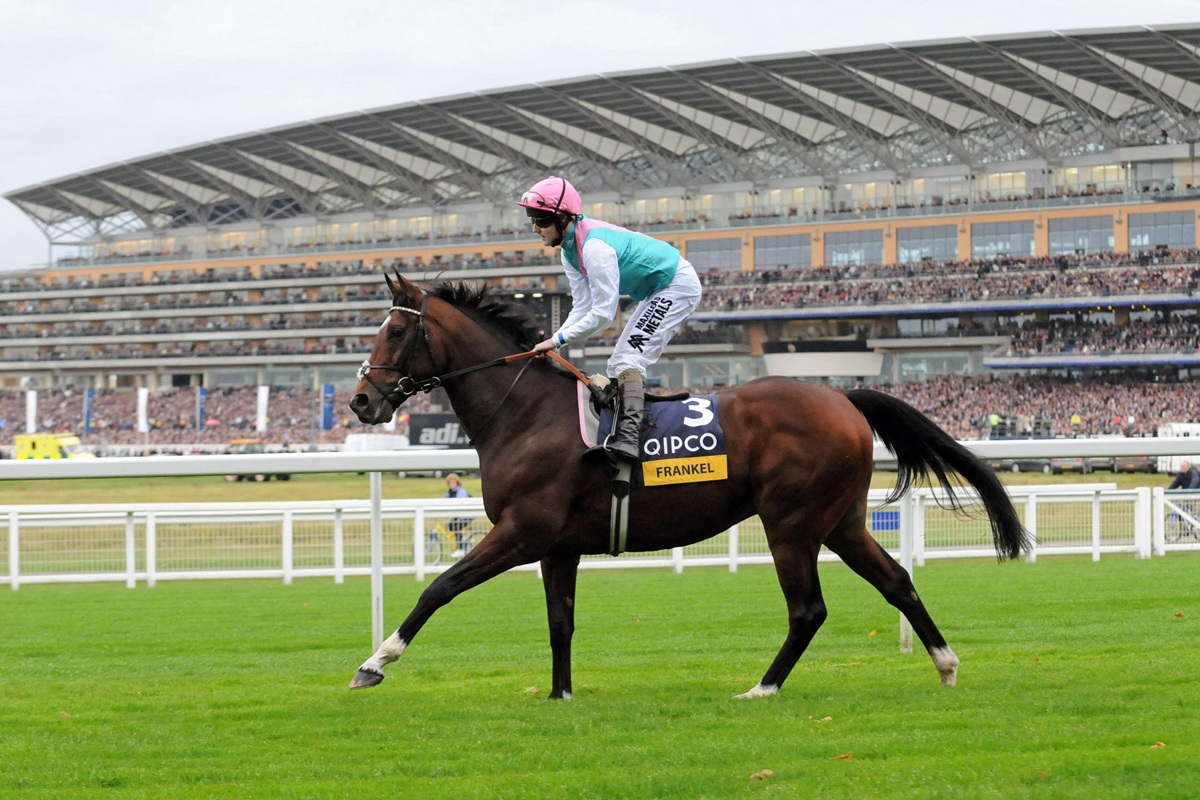
Ascot, 20 October 2012. The ground was soft with heavy patches, and Frankel had never run on anything like it. His participation was in doubt until the morning of the race, when Lord Grimthorpe walked the course and gave the nod. Then he fell out of the stalls half asleep, gave away several lengths, and still beat the previous year’s winner, Cirrus des Aigles, by a length and three-quarters, with Nathaniel two and a half lengths further back.
Thirty-two thousand people cheered him from three furlongs out. It was his fourteenth race and his fourteenth win. Afterwards, his trainer said: “He’s the best I’ve ever had, the best I’ve ever seen. I’d be very surprised if there’s ever been anything better.”
Sir Henry Cecil had eight months to live.
Bred for it.
Frankel was born in box five of the foaling unit at Banstead Manor Stud on the evening of 11 February 2008. A bay colt by Galileo out of a Listed-winning mare called Kind, bred by Juddmonte, owned by Prince Khalid Abdullah. Large white star, white snip above the nose, four white feet.
When Juddmonte came to name that year’s yearlings, they picked out the best of more than 170 of them and named him after Bobby Frankel, the American trainer who had died of leukaemia in November 2009 at the age of 68. He never saw the horse run.
Jim Power, then the stud groom at Banstead, remembered him as straightforward but sensitive, with a slight air of arrogance about him. His three-parts brother Bullet Train would become his pacemaker and work companion. His full brother Noble Mission would go on to win the Champion Stakes himself, two years after Frankel did, for Cecil’s widow.
The trainer.
In 2005, Henry Cecil saddled twelve winners all season. This was a man who had been champion trainer ten times, trained four Derby winners and eight Oaks winners. His string had gone from 200 horses to barely fifty. His second marriage had collapsed in public. His twin brother David had died of cancer in 2000. The yard was losing money, and he was talking about retiring.
He once recalled walking on the Heath at Newmarket and hearing somebody say, out loud, “That’s Henry Cecil. He should have retired a long time ago.”
Then, in 2006, he was diagnosed with stomach cancer after months of nagging discomfort in his abdomen. “There’s no point in me lying down,” he said. “If I lie down and rest, all I’ll think about is how ill I am.”
Warren Place kept going on the loyalty of Khalid Abdullah and his racing manager, Teddy Grimthorpe. The winners started coming back. Light Shift won the Oaks in 2007. And in 2010, a two-year-old colt in the white, green and pink silks walked into the yard.
Two-year-old, 2010.
He made his debut on 13 August in a mile maiden at Newmarket on soft ground and did not look like a wonder horse. He broke slowly, Tom Queally held him up, he made his move two out and got there by half a length. The horse he beat was Nathaniel, who would win the King George the following year. The pair finished five lengths clear of everything else. Colour Vision, who would win the Gold Cup two years later, was eleventh, beaten twenty-nine and a quarter lengths. It was, in hindsight, an absurd maiden.
Four weeks later, at Doncaster, only two horses turned up to take him on, and he beat them by thirteen lengths. At Ascot in the Royal Lodge, he came round the home turn and left them, ten lengths clear with Queally pushing hands and heels. The Racing Post’s man wrote that it could easily have been more. Treasure Beach, who would win the Irish Derby the next year, was beaten by nearly eleven.
The Dewhurst was billed as the two-year-old race of the century, with three unbeaten colts in it. Frankel got a bump leaving the stalls, ran too free, hung right in the closing stages, and still won by two and a quarter lengths.
At the end of his two-year-old career, Frankel was four from four with wins in a Group 1 and a Group 2.
“He’s the best I’ve ever had, the best I’ve ever seen. I’d be very surprised if there’s ever been anything better.”
Sir Henry Cecil, after the Champion Stakes, Ascot, 20 October 2012
Three-year-old, 2011.
The Greenham at Newbury was a warm-up for the first Classic of the season, the 2000 Guineas. He beat Excelebration by four lengths. Excelebration would go on to win the German Guineas by seven and the Prix du Moulin and would spend his career being the second-best miler in Europe purely because of the animal in front of him.
Then the 2000 Guineas itself. Frankel went straight to the front, which nobody expected, and had the second horse off the bridle after three furlongs. By halfway, he was fifteen lengths clear. He came home six lengths in front, the widest margin since Tudor Minstrel in 1947. People still argue about whether it was the best performance ever seen on a British racecourse.
He didn’t go to Epsom. The stamina doubts were real enough, and the decision was made to keep him at a mile. At Royal Ascot in the St James’s Palace, the pacemaker went off far too fast, Queally went after him three out, and Frankel was left in front too long. Zoffany came at him late, and he only held on by three-quarters of a length. Queally got a kicking for the ride. It is the one race in the fourteen where he looked beatable.
That June, Cecil was knighted.
The Sussex Stakes at Goodwood settled it. Sold as the Duel on the Downs, it was Frankel against Canford Cliffs, the best older miler in the world, winner of five Group 1s on the bounce, who had just beaten Goldikova. Frankel made all and won by five. Canford Cliffs was found to have a shadow on his pastern and was retired on the spot. The BHA raised Frankel’s rating from 130 to 135, making him officially the best racehorse in the world.
He signed the season off in the Queen Elizabeth II on the first Champions Day, four lengths clear of Excelebration and Immortal Verse. Timeform gave him 143, their highest mark in over forty years.
“There’s no point in me lying down. If I lie down and rest, all I’ll think about is how ill I am.”
Sir Henry Cecil, on his cancer diagnosis, 2006
Four-year-old, 2012.
The season nearly didn’t happen. In April, working on Racecourse Side, one of the Newmarket gallops, he struck into himself and injured his off-fore. During the Grand National coverage, rumours circulated that he had been retired. Grimthorpe knocked them down, the second scan came back clean, and on 5 May, he worked in public at Newmarket and pulled clear of Bullet Train and Jet Away.
The Lockinge he won by five. Cecil was measured about it, said the horse wasn’t at his best and would come on for it. He was right, because what happened at Royal Ascot a month later was the best performance of his career. Frankel took the lead three furlongs out in the Queen Anne and drew away to win by eleven lengths from Excelebration. He ran the penultimate furlong in 10.58 seconds, a shade over 42mph. Timeform put him up to 147, the highest rating they have ever awarded any horse, two pounds clear of Sea-Bird.
By now, Cecil’s treatment for cancer was taking a heavy toll. He was gaunt, radiotherapy had reduced his voice to a whisper, and he wore a felt cap to cover what the chemotherapy had done. He was too ill to travel to Goodwood on 1 August, so he did not see Frankel win a second Sussex Stakes at 1/20, the first horse ever to win the race twice.
Three weeks later came York. Ten furlongs for the first time, the one genuine question left, and the A64 jammed solid with people coming to watch. There were banners at the roadside with the horse’s name on them. Cecil went against his consultants’ advice and got there in time to saddle him.
Frankel barely came off the bridle and won by seven. In the winners’ enclosure, Cecil ran his hands down the horse’s back to show there was hardly a bead of sweat on him, half in disbelief. The crowd gave three cheers, and he turned and doffed the cap to them. Asked how it felt, he said the win had made him feel “twenty years better.”
Then it was back to Ascot in October, the soft ground, and the fourteenth.
“I cannot believe in the history of racing that there has ever been a better racehorse.”
Sir Henry Cecil
The numbers.
Fourteen runs, fourteen wins, ten of them Group 1. £2,998,302 in prize money. He won by five lengths or more in eight of his fourteen wins.
Official rating 140, which the World Thoroughbred Rankings Committee confirmed in January 2013 as the best they had assessed since ratings began in 1977, two points clear of anything else. Timeform 147, their highest ever.
Champion at two, three and four, the first horse in sixty years to manage it and only the fourth in a century. Cartier Horse of the Year in both 2011 and 2012, the only horse to win it in successive years. Top speed recorded at around 43mph.
After.
Frankel covered his first mares at Banstead Manor on Valentine’s Day 2013, in the same yard where he was born. Of 133 mares covered in that first season, 126 were scanned in foal.
Sir Henry Cecil died in hospital in Cambridge on 11 June 2013, aged seventy. He had trained twenty-five domestic Classic winners and was champion trainer ten times, and he spent the last three years of his life doing the best work he had ever done while being treated for a cancer that had been diagnosed seven years earlier.
At stud, Frankel has come close to matching what he did on the track. Cracksman won two Champion Stakes. Adayar won the Derby, Hurricane Lane the Irish Derby and the St Leger, Alpinista the Arc, and Soul Stirring the Japanese Oaks. He was champion sire in Britain and Ireland in 2021, the first British-based stallion to take the title since Mill Reef thirty-four years earlier. His fee has gone from £125,000 to £350,000. In 2021, he was among the first inductees to the British Champions Series Hall of Fame, and in 2023, Racing Post readers voted him the People’s Champion.
The two of them.
Paul Hayward wrote after the Champion Stakes that Frankel was Cecil’s masterwork, and that the handling of him was done in the middle of chemotherapy and cancer. The training was the hard part, and it gets less attention than the ratings do. Frankel, as a two-year-old and through the Guineas, was a headstrong animal who wanted to run himself into the ground. Cecil spent two years teaching him to settle without taking anything away from him, and by the last race, the horse was so relaxed he fell out of the stalls. “I’ve probably got him too relaxed,” Cecil said afterwards. “It used to be the other way round.”
Cecil said he did everything by instinct, not by the book, that he liked to think he had a feeling for his horses and that they told him what to do. He had one horse in his life that could do things no other horse could. He got him at the worst possible time, and he did not waste a single run.
“I cannot believe in the history of racing that there has ever been a better racehorse.”
Never miss a lesson
New guides, previews and history every week. Free to your inbox.
Join the mailing list