Horse Racing: A Beginner's Guide
Understanding the Sport of Kings, and everything you need to walk into your first race meeting knowing what you are looking at.
Horse racing is one of the oldest sports in the world, and the Sport of Kings is a nickname it earned rather than borrowed. Thoroughbred racing has been going for more than 300 years, and very little in sport compares to the noise of a crowd as the field comes to the final furlong.
I have followed it for more years than I care to admit, and what still strikes me is that no two people arrive at it the same way. Some come for the athleticism of the horses, some for the day out, some for the bet. Racing has a way of getting under your skin, whichever door you come through. This guide is for anyone who is curious but does not know where to start.
The Horses
Start with the horse. The breed used almost exclusively in racing is the Thoroughbred, bred over centuries to run fast and to keep running fast. They are lean, powerful animals capable of speeds over 40 miles per hour.
Each one is trained on a programme of exercise, diet and care designed to bring it to peak condition on a particular afternoon. The good ones become the stars of the sport, better known to the public than the jockeys who ride them or the trainers who prepare them.
On the Flat, the roll call includes Frankel, widely regarded as the best of the modern era, who retired unbeaten with 14 wins from 14 runs; Battaash, a sprinter with frightening speed; and the likes of Sea The Stars and Mill Reef. Over jumps, Desert Orchid gave me some of my sharpest racing memories from my college days. Kauto Star won five King George VI Chases on Boxing Day. Istabraq took three Champion Hurdles in a row, and Tiger Roll won back-to-back Grand Nationals. Ask a racing crowd about any of them, and you will get a story.
The People Involved
Every horse comes with a team around it.
The trainer prepares the horse for racing: daily exercise, diet, health, and the decision about which races to enter. A good trainer learns each horse in the yard well enough to know how to get the best out of it on the day that matters.
The jockey rides the horse in the race, guiding and encouraging it at speed. They are elite athletes, light but very strong, making tactical decisions in a fraction of a second at 35 miles per hour or more. Flat jockeys tend to be small because of strict weight limits. National Hunt jockeys are usually a little bigger, given what jump racing asks of them.
The owner funds the operation, paying training fees and jockey costs, and has a say in where the horse runs and who rides it. Ownership can be expensive, though plenty of people own a share through a syndicate, which makes it far more accessible than it sounds.
Types of Racing
British racing splits into two codes: Flat and National Hunt.
Flat racing is what it says: run on a level track with no obstacles. Distances run from a sharp five furlongs (a furlong is 220 yards, eight of them to a mile) up to marathon trips of around two and a half miles. The short races test pure speed, the long ones stamina, and the best horses are often good enough to do both.
National Hunt racing, the jumping code, comes in three forms. Hurdle races use smaller obstacles, a minimum of three and a half feet. Steeplechases, or chases, use bigger fences of at least four and a half feet. Jumping is the more dramatic of the two codes, for obvious reasons. The third form is the National Hunt Flat race, usually called a bumper, run on the hurdle course with the obstacles removed. Bumpers are for young, inexperienced horses starting their careers.
How a Race Meeting Works
A typical meeting features six to eight races over an afternoon or evening. The most useful thing you can have in your hand when you arrive is the racecard: the programme listing every race, the runners, their recent form, the jockeys, the trainers and the weights. Learning to read it is the first step to feeling at home at the track.
Before each race, the horses are paraded in the parade ring, which is your chance to look at them properly. It is also where trainers give jockeys their final instructions, and where an experienced eye can pick up a clue or two.
The races themselves vary. Maidens are for horses that have never won. Novice races are for horses with limited experience. Handicaps are among the most popular, with every horse given a weight based on its ability, which in theory gives them all an equal chance and makes the result harder to call. At the top sit the pattern races, from Listed level up to Group 1 and Grade 1, where the best horses run for the biggest prizes, the glory, and, in the case of Flat horses, the reputation that shapes their stud career later on.
Understanding Betting
Betting is a large part of the day for a lot of people, and the basics are simpler than they look.
The most common wager is a Win bet, backing a horse to finish first. An Each Way bet is two bets in one: half backs the horse to win, half backs it to finish placed, usually in the top two, three or four, depending on the size of the field. If it does not win but places, the place half still pays.
Odds tell you what you stand to win against your stake. A horse at 5/1 turns a £10 bet into £50 of winnings plus your £10 back, so £60 in total. Shorter odds, like 2/1, mean a smaller return on a horse the market rates highly. Longer odds, like 20/1, mean a bigger return on one it does not.
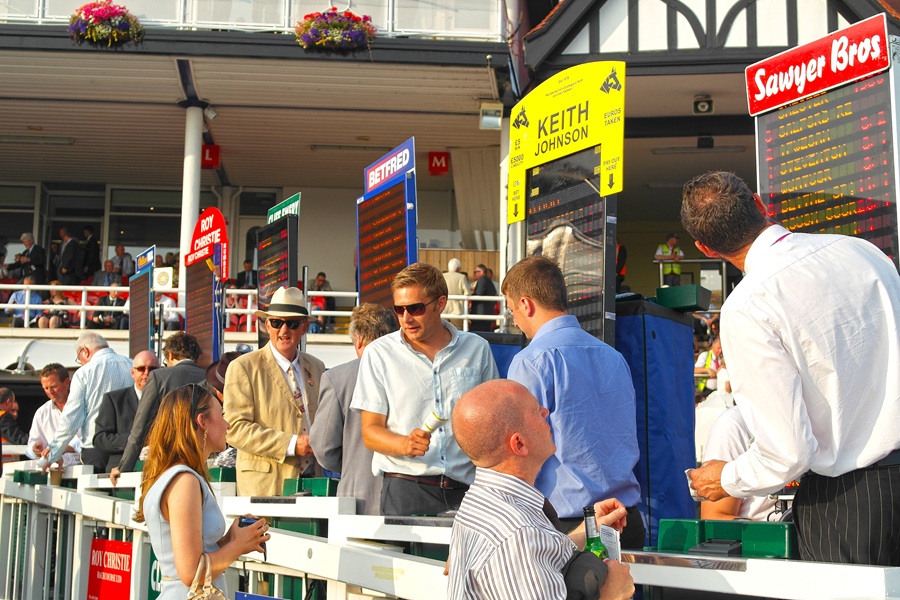
You can bet with a bookmaker at the track, through the on-course Tote, or online.
Bet only what you are comfortable losing, treat it as part of the fun, and never chase your losses.
The Race Programme
The Flat season runs mainly from mid-March to mid-November, mostly on turf, with some racing on synthetic surfaces, specifically Polytrack and Tapeta. Those are the all-weather tracks, built to give consistent racing whatever the weather. Once the turf season closes, all-weather Flat racing carries on through the winter.
National Hunt racing runs all year, with the core season from October to April and a summer campaign from May to September. Unlike the Flat, it takes place only on grass.
The calendar is punctuated by festivals that draw big crowds. On the Flat, the Epsom Derby comes in early June, the most prestigious of the Classics, with Royal Ascot and its unmatched glamour following soon after. Over jumps, the Cheltenham Festival in March is the highlight of the year, four days of the best jump racing anywhere, with an atmosphere I have not found at any other sporting event. Aintree follows, with three days of build-up to the most famous jump race of all, the Grand National.
How to Get Involved
The easiest way to start is the way I did, by watching. Most major meetings are broadcast on television or online. A few afternoons in front of the racing will teach you the rhythm of a meeting, the commentary and the shape of a race without costing you anything.
Better still, go. Most tracks offer a range of tickets, and many run beginner-friendly days where the social side matters as much as the racing. Guided tours, open days and family meetings are a good way in.
If you want to go further, look at an ownership syndicate, follow a trainer or a jockey, or pick up the Racing Post and start learning to read form properly.
Where to Start
Racing is the second-most-attended sport in Britain, behind football, drawing more than five million people a year and growing. It is a sport with long roots and a following that keeps coming back, and it can hand you an afternoon you will still be talking about years later.
Come for the spectacle, come for the day out, come for the bet, or come for the sight of a Thoroughbred in full flight. Find a meeting near you, pick up a racecard, and let the Sport of Kings do the rest.
Never miss a lesson
New guides, previews and history every week. Free to your inbox.
Join the mailing list