A Beginner's Guide to Flat Racing
Britain's Sport of Kings, and the summer game that turns a Thoroughbred into a national obsession.
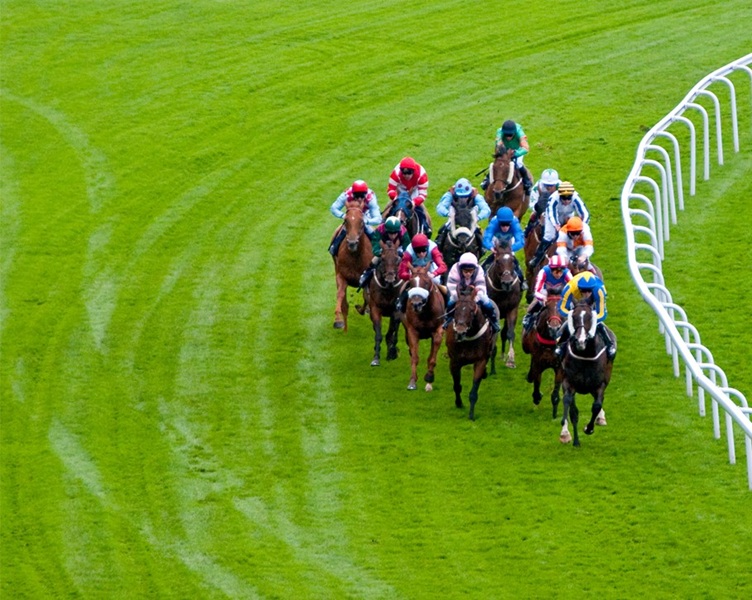
At its simplest, Flat racing is the sport in its purest form. No fences, no hurdles, just horse against horse and jockey against jockey, from the moment the stalls open to the moment the line is crossed. Plain to describe, and endlessly involved once it starts.
Races run from five furlongs, roughly half a mile, brief and explosive and over inside a minute, out to hard tests of stamina beyond a mile and three-quarters. Distance shapes everything.
Sprinters are muscular, built to accelerate hard and hold that effort over a short, fierce burst. Stayers are leaner, more economical, built to keep a rhythm going over a long trip. In between sit the great middle-distance horses, the ones who carry both speed and stamina, and who have produced some of the performances people still talk about years later.
Then there is the tactical side. A jockey at full gallop has to read the race forming around him and make decisions in fractions of a second, and those decisions are often the difference between winning and losing: when to save ground, when to make your move, where to sit among other horses travelling at 35mph. A well-judged ride on a good horse can beat a poor ride on a better one.
Under all of it is the Thoroughbred, a breed developed for speed and refined across three centuries of selective breeding. Bloodlines sit at the centre of the sport. A horse’s sire and dam hint at what it might be good at, and in the end they set its value at stud. Win the Epsom Derby or a string of Group 1s and a horse does more than collect prize money; it can be worth tens of millions as a stallion or a broodmare, its genes shaping the next crop of racehorses.
History and Heritage
British Flat racing traces back to 1174, when the first officially recorded race took place during the reign of Henry II, said to have been run at Smithfield in London during a horse fair. But it was the Stuart monarchs who shaped the sport into something we would recognise. James I made Newmarket a royal resort and began racing horses there. Charles II went further and made it the headquarters of British racing. He remains the only English king known to have ridden as a jockey as well as backing the sport as a patron.
It was not all plain sailing for the Sport of Kings. In 1654 Oliver Cromwell banned racing along with gambling, though the ban was short-lived and the Restoration brought the sport roaring back.
The 18th century was when the institutions took shape. Queen Anne brought Ascot into being, the first meeting held on 11 August 1711. The Jockey Club formed not long after, in the 1750s, and wrote the rules of racing. Then, in 1791, the first General Stud Book was published, recording Thoroughbred bloodlines to protect the breed across the generations. By the end of the century Britain had, in effect, built the template for the modern racing industry.
The horse itself was the heart of it. Every Thoroughbred racing today traces back to just three founding stallions: the Godolphin Arabian, the Byerley Turk and the Darley Arabian.
The Thoroughbred
What you have is the ultimate athlete, and the numbers are hard to believe. Thoroughbreds are among the fastest land animals, some clocked at more than 40mph. A Thoroughbred’s heart rate can pass 240 beats per minute, and its cardiac output can reach 300 litres per minute. A human heart at rest manages about 5 litres a minute; a racehorse at rest manages 35.
During hard exercise a racehorse’s breathing climbs from between 8 and 16 breaths a minute to over 150.
The upshot is horses running close together over trips from five furlongs to two and a half miles, at speeds well beyond the 20 and 30mph limits we obey in our towns.
Age and Sex Categories
It can look baffling when horses are described as a colt, a mare or a gelding. Here is the plain version of how age and sex are described in Britain.
Foal: a newly born horse, from the day it is born to 31 December of the same year.
Yearling: a horse in the first full calendar year of its life. Yearlings do not race, but they are bought and sold at several big sales, sometimes for enormous sums.
Two-year-old: the youngest a horse can run. Not all run at two, especially those from bloodlines that mature late, who tend to be weak early and fill out their frame with time.
Three-year-old: the Classic generation. A high-class, successful three-year-old can be retired to stud without ever running at four.
Older horses: four and above, often the slower-maturing sorts who may improve for another two or three years.
That covers age. As for sex:
Colt: an uncastrated male aged two to four.
Filly: a female aged two to four.
Horse: an uncastrated male of five or above.
Mare: a female of five or above.
Gelding: a castrated male of any age.
Types of Races
By distance, Flat racing runs from four and a half furlongs to two miles five furlongs and 143 yards, with plenty in between. There is just as much variety in the kinds of race you will see at a typical meeting.
Group Races
Grade 1, 2 and 3, for the top horses, where the best compete and where the effect on breeding values is greatest. Group 3 and Group 2 races give a good horse a path to improve and, if it is up to it, to tackle the Group 1s, where the prestige, the prize money and the impact on breeding make them the summit of the Flat.
Listed
A level below Group, though the gap to Group 3 is smaller than you might think. Listed races draw high-class horses and often act as a stepping stone for those who might reach Group level in time.
Handicaps
Competitive racing with horses of varying ability, each carrying a weight set so that, in theory, they would all dead-heat. They never do, but that is the idea.
Maidens
For horses that have not won. These are for the inexperienced, and they are often where careers begin, giving unraced or lightly raced horses their first chance. A horse does not have to keep running in maidens until it wins. After three runs every horse gets an official rating, which lets it run in handicaps.
Novice
For lightly raced horses showing early progress. A horse that has won up to two races can run in them, ideally as a step towards better things.
Conditions
A broad group of races where the weight carried is set by the race’s own conditions rather than by ratings, usually on age, sex or previous wins.
Classified Stakes
Lower-level races where the weight is rating-based, but not in the way a handicap is.
Selling / Claiming
The lowest class on the Flat, where horses can be bought after the race. In a seller the winner can be bought at auction straight after, and in a claimer a horse can be claimed for a set amount agreed by its connections before the race.
The Season
Flat racing runs on two surfaces. The main season, from mid-March to mid-November, is on turf. The range of British courses is unlike anywhere else, which is why you find horses that specialise at certain tracks. Brighton and Chester are nothing like Ascot or Newmarket, which are nothing like Windsor or Musselburgh. Chester is a famously tight oval barely a mile round; Newmarket is a wide, galloping track with a straight a mile and a quarter long, where the two-and-a-quarter-mile races have only one turn.
The other surface is known collectively as All-Weather, these days either Polytrack or Tapeta. The All-Weather season runs from mid-November to mid-March, though there is racing on those surfaces through the turf season too. It just tends to be of a lower grade.
The Flat Races
To say there is a lot of Flat racing in Britain is an understatement. The day-to-day programme is varied, and most of it never gets a mention outside the specialist racing sites.
Then there are the top races, the ones that reach the mainstream. Which are the key races of the Flat season depends on who you ask, but here are my ten.
- The Epsom Derby
- The King George VI and Queen Elizabeth Stakes
- The 2,000 Guineas
- The Epsom Oaks
- The 1,000 Guineas
- The St Leger
- The Juddmonte International Stakes
- The Ascot Gold Cup
- The Champion Stakes
- The Sussex Stakes
I will write about many of the big races through the year, their history and importance, and some of the best horses to have won them.
Its Place in British Culture
Racing is woven through British life. It is the country’s second-biggest sport behind football for attendance, employment and annual revenue, drawing more than five million people a year and growing. Not bad for a sport whose roots lie in the pastimes of the 17th-century aristocracy.
At the top of the social calendar sits Royal Ascot, five days each June that are about far more than the racing. The Royal Procession, begun by George IV in 1825, brings the royal family down the track in horse-drawn carriages before racing starts, and has become a symbol of the long tie between the Crown and the sport. The dress code is famously strict, and for many going, planning the outfit is as much a part of the week as studying the form. Around 300,000 attend each year, making it Britain’s best-loved meeting.
Racing reaches well beyond the great festivals, though. It is baked into the language: we talk of dark horses, front runners, going neck and neck, giving someone a head start. And it marks the British summer as reliably as anything, from Glorious Goodwood to York’s Ebor Festival to the St Leger, the final Classic at Doncaster.
It matters to rural Britain too. The industry generates around £4 billion a year in direct, indirect and associated spending, and employs roughly 20,000 people across racecourses, yards and studs, much of it in the countryside. Newmarket, Lambourn and Middleham exist largely because of racing. In Yorkshire alone the sport puts about £300 million into the regional economy each year and supports more than 3,600 full-time-equivalent jobs, most of them rural. For plenty of communities the local course is not just a sporting venue but a social hub, a source of work and a point of pride.
British Flat racing has outlasted empires, survived Cromwell and produced some of the finest athletes, human and equine, this country has seen. It is set into the land, the language and the national character in a way few sports can claim. Whatever else changes in British life, the Flat season returns each spring, the stalls open, and somewhere on a turf track a Thoroughbred runs faster than seems possible. Some things, thankfully, last.
Never miss a lesson
New guides, previews and history every week. Free to your inbox.
Join the mailing list